

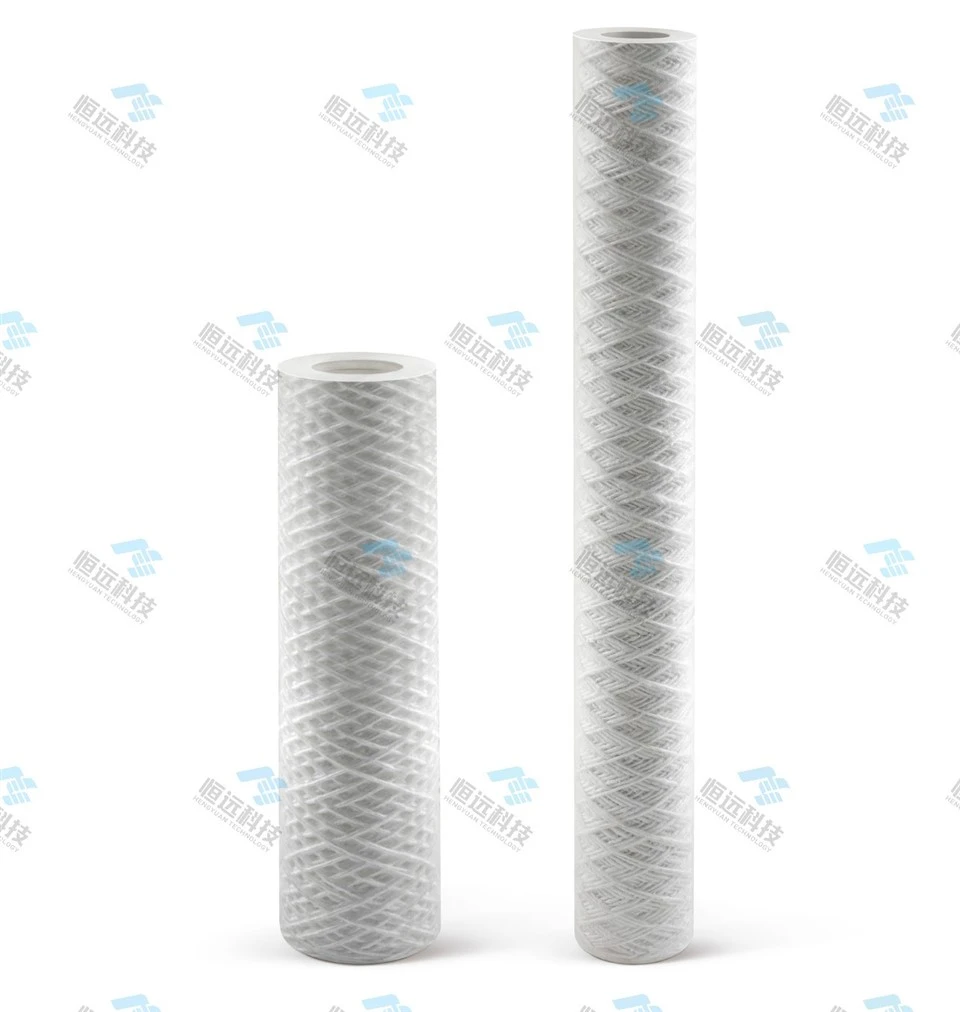


The raw materials and technical specifications of wound string filters primarily encompass their constituent materials, dimensions, filtration accuracy, pressure resistance, temperature tolerance, and other aspects. Below is a detailed elaboration on these aspects:
I. Raw Materials
The raw materials for wound string filters consist primarily of textile fiber yarns and porous skeletons. The textile fiber yarns are diverse, with common types including polypropylene fibers (PP yarn), acrylic fibers, absorbent cotton fibers, and glass fibers. These materials are precisely wound around the porous skeleton according to specific processes, forming the main body of the filter element. The porous skeleton, often made of polypropylene (PP) or stainless steel, provides structural support for the filter.
II. Technical Specifications
Dimensions:
Outer Diameter: Common outer diameters include 60mm, 63mm, 65mm, etc.
Inner Diameter: Common inner diameters are 28mm, 30mm, etc.
Length: Lengths can be customized as needed, with common specifications including 10 inches (approximately 254mm), 20 inches (approximately 508mm), 30 inches (approximately 762mm), and longer lengths of 40 inches, 60 inches, or custom sizes.
Filtration Accuracy:
Wound string filters can be manufactured with varying filtration accuracies, with common accuracies ranging from 1μm, 3μm, 5μm, 10μm, 20μm, 30μm, 50μm, 75μm, to 100μm. The choice of accuracy depends on specific application scenarios and filtration requirements.
Pressure Resistance:
The pressure resistance of filters is related to their skeleton material. Generally, filters with polypropylene skeletons have lower pressure resistance, typically ≤0.4MPa or ≤0.5MPa, while those with stainless steel skeletons offer higher pressure resistance, capable of meeting higher working pressure requirements.
Temperature Tolerance:
The temperature tolerance of filters is also related to their materials. Filters made of polypropylene typically have a maximum operating temperature of no more than 60°C or 80°C. In contrast, absorbent cotton fiber and glass fiber filters exhibit better temperature tolerance, with glass fiber filters supported by stainless steel skeletons capable of withstanding temperatures up to ≤300°C.
Other Parameters:
Wound string filters boast large dirt-holding capacity, long service life, and are non-toxic, odorless, and free from secondary pollution. Their filtration pores are designed with a larger outer diameter and a smaller inner diameter, providing excellent deep filtration effects that effectively remove suspended solids, particles, rust, and other impurities from liquids.
Hot Tags: pressure resistance wound string filters, China pressure resistance wound string filters manufacturers, suppliers, factory, HL500 III Antistatic Polyester Filter Material, Microporous PP Folded Filter Element, HBY Series Plate Air Filter, Air Filters, PP Melt Blown Filter Element, HL500 IV Water Repellent Polyester Filter Material