


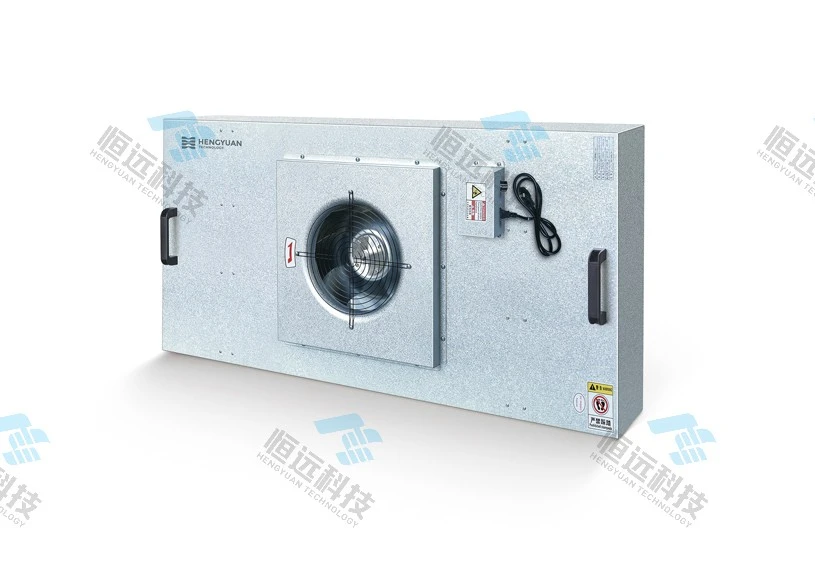
The Fan Filter Units (FFU) are devices that integrate fans and filters, primarily used in cleanrooms, laboratories, and other settings with high air quality requirements. Their classification and functions can be elaborated upon from the following aspects:
Classification:
Structural Classification:
Integrated Type: With a compact overall structure, installation and maintenance are relatively straightforward, making it suitable for spaces with limited room or requiring quick installation.
Split Type: Components such as the fan and filter are designed separately, providing greater flexibility in installation and maintenance. It is ideal for situations requiring higher cleanliness levels or more complex air processing procedures. Furthermore, the split design is more energy-efficient and environmentally friendly in the long run, while also enhancing product utilization.
Filter Below Fan Design: This design places the filter beneath the fan, facilitating better space utilization and potentially reducing air resistance and noise.
Electrical Power Classification:
AC Type: Powered by alternating current, suitable for most standard electrical environments.
DC Type: Powered by direct current, potentially offering higher energy efficiency and lower noise levels, making it suitable for situations with stricter requirements on energy efficiency and noise.
Functions:
Air Supply and Filtration: FFUs incorporate fans for air supply and are equipped with high-efficiency filters (such as HEPA or ULPA) to filter out particulates and microorganisms from the air, providing a clean air environment. The fan, typically located at the top of the FFU, sucks in air and expels clean air through the filter.
Clean Environment Control: Widely used in cleanrooms, clean benches, clean production lines, etc., FFUs ensure that air quality meets specific standards. In industries like semiconductor manufacturing, pharmaceutical production, optics, and biotechnology, FFUs are crucial for controlling air contaminants.
Modular Design: FFUs often feature a modular design for easy installation, maintenance, and upgrades. Users can select and combine modules of different specifications and performance according to actual needs, meeting the demands of various clean environments.
Energy Efficiency and Low Noise: Some FFUs are designed for energy efficiency, allowing for the adjustment of airflow to enhance energy performance. Additionally, well-designed FFUs exhibit low noise levels, making them suitable for settings with strict noise requirements.
Airflow Optimization: FFUs optimize airflow patterns through built-in ductwork and airflow guidance systems, reducing noise and pressure loss while enhancing fan efficiency. This ensures even air distribution and flow speed within cleanrooms.
Flexibility and Adaptability: FFUs are designed with overall flexibility, allowing for easy installation with various ceiling frameworks. They can meet various cleanliness levels (e.g., Class 1-1000) and be arranged as standalone units or multiple units in series to form assembly lines according to process requirements.
Quality Assurance: High-quality FFU products undergo rigorous quality testing before leaving the factory, such as individual scanning inspections using particle counters, to ensure their performance and reliability.
In conclusion, Fan Filter Units possess diverse classification methods and an array of functional characteristics, enabling them to cater to the needs of various industries and settings for clean air environments. When selecting and using FFUs, comprehensive consideration and assessment based on specific requirements are essential.
Hot Tags: fan filter units for clean room, China fan filter units for clean room manufacturers, suppliers, factory, HNWn600 Glass Fiber Needle Punched Filter Material, Gearbox Filter Element Hydraulic Oil Filter, HYT Series Communication Equipment Filter, Wind Power Filter Element, Air Compressor Filter, High Temerature Resistant Filter